
Publicado el Deja un comentario

Error web no segura – SSL [1 de 3]

1. El problema: Error «Web no segura»

Llevaba meses sin entrar a mi propia página web (conquistandolugares.es). Para ser sincero, la última vez que accedí al servidor fue para lidiar con un problema raro de la licencia de Plesk (un temita con bastante miga que ya desarrollaré en otra entrada del blog).

El caso es que hoy me dio por entrar para echar un vistazo y, de repente, ¡pantallazo rojo al canto! El navegador me recibió con una alerta bastante fea diciendo que la web no era segura.
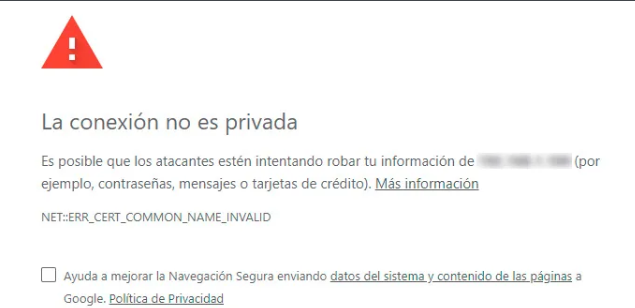
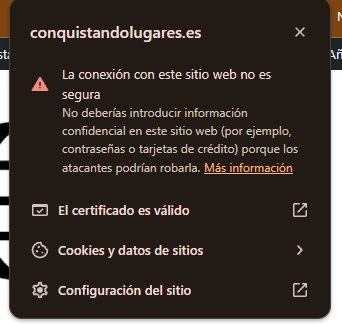
Advertencia de sitio web no seguro en el navegador al acceder a conquistandolugares.es
El temido pantallazo de conexión no privada.
Detalle del certificado SSL caducado en el servidor web
Detalle del error técnico del certificado expirado.

Ver eso en tu propia web te da un vuelco al corazón 😅. ¡Oye, un momento! ¡Que yo no le voy a robar datos ni tarjetas a nadie, que solo quiero compartir mis contenidos! Pero claro, ponte en el lugar de cualquier persona que visite la web: ve semejante cartelón de peligro y lo primero que piensa es que el sitio es sospechoso. Resultado: espantada generalizada de visitas.

Como el problema era que el certificado SSL había caducado, la solución rápida que todos conocemos era conectar por SSH desde PowerShell y renovarlo en un par de minutos. Pero el servidor decidió que hoy no era mi día de suerte y me soltó un portazo en la cara:

Connection closed by 212.227.229.115 port 22

¡Sin acceso por SSH! Mi única vía de rescate era entrar al panel de control de mi proveedor en Piensa Solutions y acceder a la consola web remota KVM/VNC de mi VPS.

Y ahí fue donde la cosa se complicó de verdad:

  • Sin portapapeles: En la consola web de Piensa Solutions no se podía copiar ni pegar de forma normal. Tuve que teclear las órdenes directamente a mano en pantalla.
  • El teclado poseído: La consola web forzó la distribución de teclado en inglés (US). Querías escribir una simple comilla ("), una barra (/) o un punto y coma (;) y en pantalla salían caracteres completamente distintos.

Dado lo que me ha costado mi buen tiempo resolver este rompecabezas, he grabado un vídeo explicando todo el proceso en detalle y he documentado la solución en este post paso a paso:

Vídeo explicativo: Solucionando el acceso SSH y la consola web en Piensa Solutions.

2. ¿Cómo soluciono esto?

Herramientas utilizadas

  • Consola Web KVM/VNC: Panel de gestión de VPS en Piensa Solutions.
  • PowerShell (Windows) / Terminal (macOS/Linux): Para la conexión SSH definitiva una vez desbloqueado el acceso.

Paso a paso para solucionar el bloqueo

Para evitar pelearnos con editores interactivos como nano o vim en una consola web lenta y con el teclado desconfigurado, inyectaremos las reglas de acceso directamente al archivo /etc/ssh/sshd_config. Lo haremos comando a comando, de uno en uno y sin comillas dobles para asegurarnos de que el servidor procesa la orden limpia sin errores de sintaxis.

Paso 1: Permitir el acceso del usuario root

Escribimos la primera línea en la consola web y pulsamos Enter:

echo PermitRootLogin yes >> /etc/ssh/sshd_config

Paso 2: Habilitar la autenticación por contraseña

Escribimos la segunda línea en la consola web y pulsamos Enter:

echo PasswordAuthentication yes >> /etc/ssh/sshd_config

Paso 3: Reiniciar el servicio SSH

Reiniciamos el demonio de SSH para aplicar los cambios en el sistema:

systemctl restart sshd

Paso 4: Conexión remota por SSH desde tu propia terminal

En cuanto la terminal web devuelva la línea de comandos limpia ([root@server-wp-conquistando-lugares ~]#), podemos abandonar la consola del navegador. Abre la PowerShell de tu ordenador y conéctate directamente introduciendo tus datos:

ssh root@212.227.229.115

*(Nota: En tu caso, deberás sustituir 212.227.229.115 por la dirección IP pública o el dominio de tu propio servidor VPS, e introducir la contraseña de root cuando te la solicite).*


3. Ya está funcionando

Resultado obtenido

Conseguimos saltarnos las restricciones de la consola web y recuperar el control total del servidor mediante SSH nativo desde nuestra propia terminal de PowerShell.

Comprobaciones finales

  1. Prompt del servidor activo: Confirmamos que PowerShell muestra el mensaje de bienvenida oficial y el indicador de comandos remotos ([root@server-wp-conquistando-lugares ~]#).
  2. Portapapeles operativo: Comprobamos que el clic derecho en PowerShell permite copiar y pegar comandos largos al instante.
  3. Mapeo correcto del teclado: Comillas, barras inclinadas y guiones vuelven a escribirse perfectamente desde nuestra terminal habitual.

📊 Ficha técnica del proceso:
⏱️ Tiempo empleado: ~45 minutos (luchando con la consola web y la distribución de teclado).
🤯 Nivel de dificultad: Medio / Frustrante (debido a las limitaciones del visor web KVM).

Publicado el Deja un comentario

🚀 Master Your Data Analytics Tools: Module 2 Quick Guide!

🚀 Master Your Data Analytics Tools: Module 2 Quick Guide!

Understanding the Data Life Cycle and the Data Analysis Process is the bread and butter of any successful data analyst[cite: 138]. Whether you are prepping for a certification or just brushing up on your skills, choosing the right tool for the job is essential for efficiency and accuracy[cite: 139].

Google Data Analytics Module 2 Challenge Answers and Data Life Cycle steps


🎯 Google Data Analytics Module 2 Challenge: Key Concepts

Ace your certification with this complete guide. These summaries cover the critical stages of the data life cycle and the essential steps of the data analysis process[cite: 161, 163].

🔄 Data Life Cycle Summary

  • Plan Phase: When a team considers how to manage data and who is responsible for it at the start of a project, they are in the Plan phase[cite: 6, 169]. This involves setting the foundation and determining technical logistics[cite: 111, 113, 169].
  • Capture Phase: Gathering data from outside databases and internal files for the first time occurs during the Capture phase[cite: 10, 150, 172].
  • Manage Phase: To manage data effectively, you must choose where it will be stored, determine which tools safeguard it, and consider how to care for that data[cite: 1, 165].
  • Archive and Destroy: Archiving involves storing data even if it may not be used again[cite: 3, 166]. Destruction (like using shredders for paper) is vital for protecting sensitive customer information[cite: 3, 166].

🔍 Data Analysis Process Summary

  • Ask Step: Defining the problem to be solved and staying engaged with stakeholders through dialogue[cite: 4, 153, 174].
  • Prepare Step: Data is collected and stored for future analysis[cite: 5, 176]. Analysts ensure data is properly organized before processing[cite: 121, 176].
  • Process Step: This phase focuses specifically on data cleaning, such as fixing inaccuracies and typos in a dataset[cite: 7, 154, 178].
  • Analyze Step: Analysts use query languages (SQL) to drive informed decision-making and extract insights[cite: 8, 155, 180].

📚 Comprehensive Question & Answer Key

Completing the Module 2 Challenge is a huge milestone! Here are the exact results from our latest session to help you get that certificate[cite: 161, 163]:

  1. Which of the following activities are part of the manage phase of the data life cycle? (Select all that apply)
    • Determine which tools will be most effective at safeguarding data [cite: 1, 165]
    • Choose where the data will be stored [cite: 1, 165]
    • Consider how best to care for data [cite: 1, 165]
  2. Which spreadsheet feature uses a set of instructions to perform calculations, such as multiplication or division?
    • Answer: Formula [cite: 2, 90, 182]
  3. Which of the following statements correctly describe the archive and the destroy phases of the data life cycle? (Select all that apply)
    • Archiving means storing data, although it may not be used again [cite: 3, 166]
    • Shredders may be used to destroy data that is on paper [cite: 3, 166]
    • A key reason for destroying data is to protect sensitive customer information [cite: 3, 166]
  4. What tasks may occur during the ask step of the data analysis process? (Select all that apply)
    • Stay engaged by having a dialogue with stakeholders [cite: 4, 153, 174]
    • Define the problem to be solved [cite: 4, 153, 174]
    • Consider the current state compared to the ideal state [cite: 4, 174]
  5. Fill in the blank: During the prepare step of the data analysis process, data is collected and _______ for analysis.
    • Answer: stored [cite: 5, 176]
  6. Scenario: Company leaders ask the data team to investigate supplier performance. The team considers how to manage data and who is responsible for it. What phase of the data life cycle does this describe?
    • Answer: Plan [cite: 6, 122, 169]
  7. Scenario: A data professional fixes typos and inaccuracies in a dataset and shares cleaning procedures with stakeholders. What step of the data analysis process does this describe?
    • Answer: Process [cite: 7, 154, 178]
  8. Fill in the blank: During the _______ step of the data analysis process, data analytics professionals use tools such as query languages to drive informed decision-making.
    • Answer: analyze [cite: 8, 155, 180]
  9. What are some key benefits of data visualizations? (Select all that apply)
    • Data visualizations enable stakeholders to identify trends more easily [cite: 9, 158, 183]
    • Graphs and charts offer a clear and concise overview of the data [cite: 9, 158, 183]
    • Insights that are visualized can be more quickly shared and understood [cite: 9, 100, 183]
  10. Scenario: An agriculture company collects data from an outside commodity market database and internal files. This work occurs during the _______ phase of the data life cycle.
    • Answer: capture [cite: 10, 150, 172]

Following these structured phases ensures your projects focus on the right business goals while keeping data secure[cite: 112, 118]. Using tools like Tableau or SQL at the right time is the secret to moving from raw numbers to impactful stories[cite: 117, 119]! 📊💻

#DataAnalytics #Module2Challenge #SQL #DataLifeCycle #Success #GoogleDataAnalytics

Correct answers for Google Data Analytics Module 2 Challenge regarding data life cycle and analysis process

Publicado el Deja un comentario

📝 Updated Blog Post: Diving Into Data 📊✨

Google Data Analytics Module 1 Graded Assignment Questions and Answers on a dual monitor setup with espresso

Ever felt like the world is just a giant pile of numbers waiting to be organized? 🧐 That’s exactly how I felt before clicking «Start» on the Google Data Analytics Professional Certificate

Ever felt like the world is just a giant pile of numbers waiting to be organized? 🧐 That’s exactly how I felt before clicking «Start» on the Google Data Analytics Professional Certificate. Today, I’m breaking down my experience with Module 1: Foundations: Data, Data, Everywhere. Let’s dive in! 🌊

Why Data Analytics? Why Now? 📈

We live in a world where every click, purchase, and heartbeat generates data. But data without analysis is just noise. 📢 Through this course, I’m learning how to turn that noise into insights that actually solve problems. Whether it’s optimizing a business or even planning a home renovation project 🏡, the power of a technical mindset is real.

Key Takeaways from Module 1 🧠💡

Module 1 is all about the «Foundations.» Here are the three concepts that totally changed my perspective this week:

  • Gap Analysis: It’s not just for businesses! It’s the art of looking at where you are now vs. where you want to be and building the bridge to get there. 🌉
  • Data-Driven Decision Making: Moving past «gut feelings» and using actual facts to guide strategy. It’s about being confident in your «Why.» 🎯
  • The 5 Whys: A simple but lethal tool for finding the root cause of any problem. Ask «why» five times, and you’ll peel back the layers until you find the truth. 🕵️‍♂️

Cracking the Code: Module 1 Graded Assignment Walkthrough 🔍

To help fellow students, I’ve put together a quick guide to some of the trickiest questions from the Introducing Data Analytics and Analytical Thinking assessment. Understanding the logic is the key to passing!

Q: Which statements correctly describe data and data analysis?

Answers: Data is a collection of facts; One goal of analysis is to make predictions; Collecting data is part of the process.

💡 Why: Remember that «Data Analytics» is the broad science, while «Data Analysis» is the specific process of collecting and organizing those facts to look into the future.

Q: Data science involves using _____ data to create new ways of modeling?

Answer: Raw.

💡 Why: Data scientists often work with «raw» or unrefined data to build entirely new ways of understanding the unknown.

Q: What does a «Technical Mindset» involve?

Answer: Breaking down complex elements into smaller pieces.

💡 Why: It’s all about logic. If a problem is too big, an analyst breaks it into bite-sized, manageable steps.

Q: What is a «Gap Analysis»?

Answer: Evaluating the current state of a process to identify future improvements.

💡 Why: If a pet shelter wants more donations, they look at where they are now (current) vs. where they want to be (future) to find the «gap.»

Q: What is the «Root Cause»?

Answer: Why a problem occurs.

💡 Why: We aren’t looking for the symptoms; we want the fundamental reason the issue started in the first place.


The Road Ahead 🛣️

The journey has just begun. I’ve just wrapped up the first big challenge and am moving into the Data Life Cycle (Plan, Capture, Manage, Analyze, Archive, and Destroy). My goal? To master the tools—from SQL to R—and eventually build a killer capstone project.

Are you also taking the Google Data Analytics course? Or maybe you’re thinking about a career pivot? Let’s connect in the comments! 👇

#DataAnalytics #GoogleCertificate #ContinuousLearning #DataScience #CareerPivot #TechMindset #StudyGuide #GoogleDataAnalyticsAnswers 💻🔥

Publicado el Deja un comentario

🚀 My Google Data Analytics Journey: Understanding the Data Ecosystem (Part 3)

Welcome back to my learning diary! As I work toward my Google Data Analytics Professional Certificate and prepare for my Cambridge B2 exam, I am documenting every step. Today, I am diving into the «Data Ecosystem»—the invisible world where data lives, breathes, and helps us make smarter choices. 📊

📑 Index

  1. The Ancient Origins of Data Analysis
  2. What is a Data Ecosystem?
  3. Making Better, Data-Driven Decisions
  4. Data vs. Gut Instinct: The Detective’s Dilemma
  5. Key Takeaways & Knowledge Check

🏛️ 1. The Ancient Origins of Data Analysis

Did you know that data analysis isn’t a modern invention? It is rooted in statistics, which goes back as far as Ancient Egypt.

  • The Pyramids: Egyptians used papyri to record calculations and theories, creating the earliest versions of spreadsheets.
  • Evolution: While the tools have changed, the core idea—collecting information to drive success—remains the same.

🌐 2. What is a Data Ecosystem?

A data ecosystem is a collection of interacting elements that produce, manage, store, and share data. Think of it like a biological ecosystem, but for information!

The three main pillars are:

  • Hardware & Software: The physical and digital tools we use.
  • People: The analysts (like us!) who harness the power of the data.
  • The Cloud: A virtual location that allows us to access data over the internet instead of local hard drives.

💡 3. Making Better, Data-Driven Decisions

Data-driven decision-making means using facts to guide business strategy. Instead of guessing, organizations use data to solve problems like low employee retention or improving brand recognition.

Pro Tip: Always involve Subject Matter Experts (SMEs). These are people familiar with the business problem who can help identify inconsistencies and validate your findings.

🕵️ 4. Data vs. Gut Instinct: The Detective’s Dilemma

Data analysts are like detectives; both follow clues and collect evidence to find the truth.

  • Gut Instinct: This is an intuitive «feeling» based on past experience.
  • The Risk: Relying only on a hunch can lead to biased or costly mistakes.
  • The Solution: Find the «perfect blend» of data and business knowledge. Use more data for high-resource projects, and lean more on experience for «rush» projects

📝 5. Key Takeaways & Knowledge Check

To wrap up Part 3, remember that the Google Data Analysis Process follows six clear steps: Ask, Prepare, Process, Analyze, Share, and Act. Whether you are analyzing taxi ride demand or helping a retail store predict purchases, these fundamentals will keep you on track!

Publicado el Deja un comentario

Learning Data Analytics with Google’s Certificate – My Study Diary

1️⃣Introduction

In this series of posts, I will document my journey through the Google Data Analytics Professional Certificate on Coursera. I was fortunate to receive a scholarship from Google, and I decided to take the course in English to improve both my data analytics skills and my English writing while preparing for the Cambridge B2 exam. My goal is to create a learning diary where I summarize the most important concepts from each lesson, reflect on what I learn, and gradually build a personal knowledge base about data analysis, analytical thinking, and real-world applications of data

2️⃣Introduction to Data Analytics

The first video introduces the importance of data in today’s world. Many industries such as e-commerce, healthcare, finance, marketing, and technology rely heavily on data to improve their processes, identify opportunities, develop new products, and make better decisions. Data can be understood as a collection of facts, including numbers, images, words, measurements, observations, or videos. Data analysis is the process of collecting, transforming, and organizing this information in order to draw conclusions and support informed decision-making.

The lesson also emphasizes that data is everywhere. Every time we search online, stream music, use GPS, read product reviews, shop online, or post something on social media, we are both using and creating data. The amount of data generated globally is enormous. For example, Google processes more than 40,000 searches per second, which represents billions of searches every day. Because of this massive amount of information, organizations increasingly depend on data analysts to interpret data and help guide strategic decisions.

The course also introduces the main stages of the data analysis process: 1) Ask 2) Prepare 3) Process 4) Analyze 5) Share 6) Act

These steps form the framework that will guide the entire certificate program.


3️⃣ Googlers introduced in the video

Several Google professionals appear in the video to explain different aspects of data analytics and share their experience working in the industry:

  • Tony — Program Manager at Google and Data Analyst
    Introduces the course and explains the importance of data analytics.
  • Angie — Program Manager of Engineering at Google
    Explains the importance of data cleaning and how understanding data deeply can feel like solving a mystery.
  • Alex — Research Scientist at Google
    Studies the impact of artificial intelligence on society and users.
  • Lila Jones — Member of the Google Cloud team
    Leads teams that help customers move their systems and data to cloud technologies.
  • Evan — Learning Portfolio Manager at Google
    Designs educational programs and training related to big data technologies.

Later in the course, other instructors will guide each stage of the analytics process.


4️⃣ Personal reflections

Something that surprised me

The number of industries where data analysts can contribute. Data analytics is useful in many fields such as healthcare, finance, marketing, technology, and e-commerce.

Something I already knew

The idea that data is everywhere. The analytical process also reminds me of the DAFO (SWOT) analysis framework, where structured steps help analyze a situation and make better decisions.

Something new I learned

I learned how many different teams work at Google and how data plays a role in many areas such as engineering, research, cloud computing, and education.

5️⃣ Why I’m Taking This Course

I decided to take the Google Data Analytics Professional Certificate after receiving a scholarship from Google. Data is becoming increasingly important in almost every industry, and I wanted to better understand how organizations use data to make decisions and solve real-world problems.

Another reason I chose this course is that I want to improve my professional skills while also practicing my English. Since I am preparing for the Cambridge B2 exam, I decided to complete the entire course in English and document my learning process through this blog.

By writing about each lesson, I hope to reinforce what I learn, improve my technical vocabulary, and build a personal record of my progress in data analytics. Over time, this learning diary will also become a small portfolio that shows how my understanding of data analysis develops step by step.

Title (H1)
Starting the Google Data Analytics Certificate

Heading (H2)
Introduction

Heading (H2)
What is Data Analytics?

Heading (H2)
The Data Analysis Process

Heading (H2)
My Personal Notes

Heading (H2)
What I Learned in This Lesson