
Publicado el Deja un comentario

📝 Updated Blog Post: Diving Into Data 📊✨

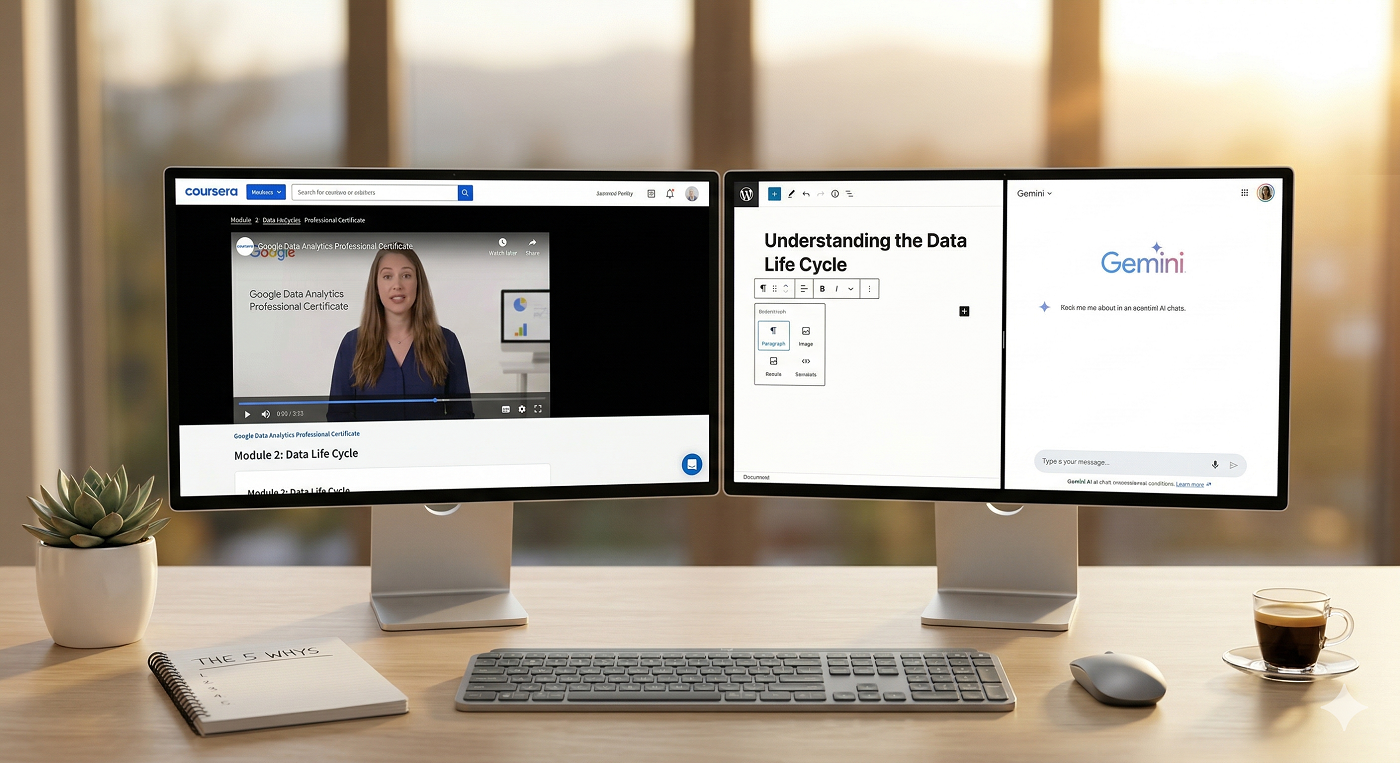
Google Data Analytics Module 1 Graded Assignment Questions and Answers on a dual monitor setup with espresso

Ever felt like the world is just a giant pile of numbers waiting to be organized? 🧐 That’s exactly how I felt before clicking «Start» on the Google Data Analytics Professional Certificate

Ever felt like the world is just a giant pile of numbers waiting to be organized? 🧐 That’s exactly how I felt before clicking «Start» on the Google Data Analytics Professional Certificate. Today, I’m breaking down my experience with Module 1: Foundations: Data, Data, Everywhere. Let’s dive in! 🌊

Why Data Analytics? Why Now? 📈

We live in a world where every click, purchase, and heartbeat generates data. But data without analysis is just noise. 📢 Through this course, I’m learning how to turn that noise into insights that actually solve problems. Whether it’s optimizing a business or even planning a home renovation project 🏡, the power of a technical mindset is real.

Key Takeaways from Module 1 🧠💡

Module 1 is all about the «Foundations.» Here are the three concepts that totally changed my perspective this week:

  • Gap Analysis: It’s not just for businesses! It’s the art of looking at where you are now vs. where you want to be and building the bridge to get there. 🌉
  • Data-Driven Decision Making: Moving past «gut feelings» and using actual facts to guide strategy. It’s about being confident in your «Why.» 🎯
  • The 5 Whys: A simple but lethal tool for finding the root cause of any problem. Ask «why» five times, and you’ll peel back the layers until you find the truth. 🕵️‍♂️

Cracking the Code: Module 1 Graded Assignment Walkthrough 🔍

To help fellow students, I’ve put together a quick guide to some of the trickiest questions from the Introducing Data Analytics and Analytical Thinking assessment. Understanding the logic is the key to passing!

Q: Which statements correctly describe data and data analysis?

Answers: Data is a collection of facts; One goal of analysis is to make predictions; Collecting data is part of the process.

💡 Why: Remember that «Data Analytics» is the broad science, while «Data Analysis» is the specific process of collecting and organizing those facts to look into the future.

Q: Data science involves using _____ data to create new ways of modeling?

Answer: Raw.

💡 Why: Data scientists often work with «raw» or unrefined data to build entirely new ways of understanding the unknown.

Q: What does a «Technical Mindset» involve?

Answer: Breaking down complex elements into smaller pieces.

💡 Why: It’s all about logic. If a problem is too big, an analyst breaks it into bite-sized, manageable steps.

Q: What is a «Gap Analysis»?

Answer: Evaluating the current state of a process to identify future improvements.

💡 Why: If a pet shelter wants more donations, they look at where they are now (current) vs. where they want to be (future) to find the «gap.»

Q: What is the «Root Cause»?

Answer: Why a problem occurs.

💡 Why: We aren’t looking for the symptoms; we want the fundamental reason the issue started in the first place.


The Road Ahead 🛣️

The journey has just begun. I’ve just wrapped up the first big challenge and am moving into the Data Life Cycle (Plan, Capture, Manage, Analyze, Archive, and Destroy). My goal? To master the tools—from SQL to R—and eventually build a killer capstone project.

Are you also taking the Google Data Analytics course? Or maybe you’re thinking about a career pivot? Let’s connect in the comments! 👇

#DataAnalytics #GoogleCertificate #ContinuousLearning #DataScience #CareerPivot #TechMindset #StudyGuide #GoogleDataAnalyticsAnswers 💻🔥

Publicado el Deja un comentario

🚀 My Google Data Analytics Journey: Understanding the Data Ecosystem (Part 3)

Welcome back to my learning diary! As I work toward my Google Data Analytics Professional Certificate and prepare for my Cambridge B2 exam, I am documenting every step. Today, I am diving into the «Data Ecosystem»—the invisible world where data lives, breathes, and helps us make smarter choices. 📊

📑 Index

  1. The Ancient Origins of Data Analysis
  2. What is a Data Ecosystem?
  3. Making Better, Data-Driven Decisions
  4. Data vs. Gut Instinct: The Detective’s Dilemma
  5. Key Takeaways & Knowledge Check

🏛️ 1. The Ancient Origins of Data Analysis

Did you know that data analysis isn’t a modern invention? It is rooted in statistics, which goes back as far as Ancient Egypt.

  • The Pyramids: Egyptians used papyri to record calculations and theories, creating the earliest versions of spreadsheets.
  • Evolution: While the tools have changed, the core idea—collecting information to drive success—remains the same.

🌐 2. What is a Data Ecosystem?

A data ecosystem is a collection of interacting elements that produce, manage, store, and share data. Think of it like a biological ecosystem, but for information!

The three main pillars are:

  • Hardware & Software: The physical and digital tools we use.
  • People: The analysts (like us!) who harness the power of the data.
  • The Cloud: A virtual location that allows us to access data over the internet instead of local hard drives.

💡 3. Making Better, Data-Driven Decisions

Data-driven decision-making means using facts to guide business strategy. Instead of guessing, organizations use data to solve problems like low employee retention or improving brand recognition.

Pro Tip: Always involve Subject Matter Experts (SMEs). These are people familiar with the business problem who can help identify inconsistencies and validate your findings.

🕵️ 4. Data vs. Gut Instinct: The Detective’s Dilemma

Data analysts are like detectives; both follow clues and collect evidence to find the truth.

  • Gut Instinct: This is an intuitive «feeling» based on past experience.
  • The Risk: Relying only on a hunch can lead to biased or costly mistakes.
  • The Solution: Find the «perfect blend» of data and business knowledge. Use more data for high-resource projects, and lean more on experience for «rush» projects

📝 5. Key Takeaways & Knowledge Check

To wrap up Part 3, remember that the Google Data Analysis Process follows six clear steps: Ask, Prepare, Process, Analyze, Share, and Act. Whether you are analyzing taxi ride demand or helping a retail store predict purchases, these fundamentals will keep you on track!

Publicado el Deja un comentario

Learning Data Analytics with Google’s Certificate – My Study Diary

1️⃣Introduction

In this series of posts, I will document my journey through the Google Data Analytics Professional Certificate on Coursera. I was fortunate to receive a scholarship from Google, and I decided to take the course in English to improve both my data analytics skills and my English writing while preparing for the Cambridge B2 exam. My goal is to create a learning diary where I summarize the most important concepts from each lesson, reflect on what I learn, and gradually build a personal knowledge base about data analysis, analytical thinking, and real-world applications of data

2️⃣Introduction to Data Analytics

The first video introduces the importance of data in today’s world. Many industries such as e-commerce, healthcare, finance, marketing, and technology rely heavily on data to improve their processes, identify opportunities, develop new products, and make better decisions. Data can be understood as a collection of facts, including numbers, images, words, measurements, observations, or videos. Data analysis is the process of collecting, transforming, and organizing this information in order to draw conclusions and support informed decision-making.

The lesson also emphasizes that data is everywhere. Every time we search online, stream music, use GPS, read product reviews, shop online, or post something on social media, we are both using and creating data. The amount of data generated globally is enormous. For example, Google processes more than 40,000 searches per second, which represents billions of searches every day. Because of this massive amount of information, organizations increasingly depend on data analysts to interpret data and help guide strategic decisions.

The course also introduces the main stages of the data analysis process: 1) Ask 2) Prepare 3) Process 4) Analyze 5) Share 6) Act

These steps form the framework that will guide the entire certificate program.


3️⃣ Googlers introduced in the video

Several Google professionals appear in the video to explain different aspects of data analytics and share their experience working in the industry:

  • Tony — Program Manager at Google and Data Analyst
    Introduces the course and explains the importance of data analytics.
  • Angie — Program Manager of Engineering at Google
    Explains the importance of data cleaning and how understanding data deeply can feel like solving a mystery.
  • Alex — Research Scientist at Google
    Studies the impact of artificial intelligence on society and users.
  • Lila Jones — Member of the Google Cloud team
    Leads teams that help customers move their systems and data to cloud technologies.
  • Evan — Learning Portfolio Manager at Google
    Designs educational programs and training related to big data technologies.

Later in the course, other instructors will guide each stage of the analytics process.


4️⃣ Personal reflections

Something that surprised me

The number of industries where data analysts can contribute. Data analytics is useful in many fields such as healthcare, finance, marketing, technology, and e-commerce.

Something I already knew

The idea that data is everywhere. The analytical process also reminds me of the DAFO (SWOT) analysis framework, where structured steps help analyze a situation and make better decisions.

Something new I learned

I learned how many different teams work at Google and how data plays a role in many areas such as engineering, research, cloud computing, and education.

5️⃣ Why I’m Taking This Course

I decided to take the Google Data Analytics Professional Certificate after receiving a scholarship from Google. Data is becoming increasingly important in almost every industry, and I wanted to better understand how organizations use data to make decisions and solve real-world problems.

Another reason I chose this course is that I want to improve my professional skills while also practicing my English. Since I am preparing for the Cambridge B2 exam, I decided to complete the entire course in English and document my learning process through this blog.

By writing about each lesson, I hope to reinforce what I learn, improve my technical vocabulary, and build a personal record of my progress in data analytics. Over time, this learning diary will also become a small portfolio that shows how my understanding of data analysis develops step by step.

Title (H1)
Starting the Google Data Analytics Certificate

Heading (H2)
Introduction

Heading (H2)
What is Data Analytics?

Heading (H2)
The Data Analysis Process

Heading (H2)
My Personal Notes

Heading (H2)
What I Learned in This Lesson